

Money is often misunderstood as something to be chased, accumulated or controlled. In reality, money behaves more like energy—it flows and moves in response to deeper principles. It is not random, emotional or mystical. It is obedient. It responds to alignment.
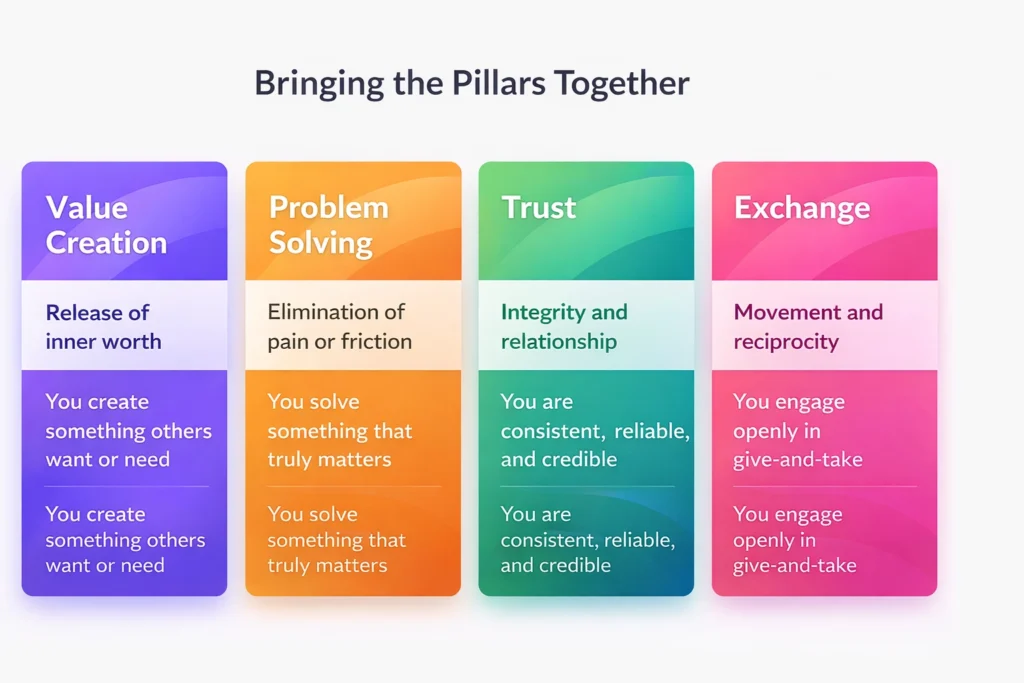
At its core, money flows in response to four foundational pillars: value creation, problem solving, trust and exchange. Understanding these pillars shifts the focus from pursuing money to cultivating the conditions that naturally attract it.
Pillar 1: Value creation – Value is what you release that benefits others. It may take the form of a product that improves daily life, a service that solves a problem, a message that brings healing or clarity, a skill that enhances outcomes or even an atmosphere that hosts peace, joy, or excellence. Value creation is the intentional process of producing goods, services, or experiences that others perceive as meaningful, useful, or desirable. Money does not chase people—it chases value. Wherever value is generated, money gravitates. An artist who creates a compelling portrait, a startup that builds time-saving software or a coach who unlocks hidden potential are all engaging in value creation. The scale of money that flows corresponds not to effort but to contribution. We live in a world that rewards what is seen, felt and received as valuable. When you carry value, you do not need to pursue money; money follows where value leads.
Pillar 2: Problem solving – Problem solving is the act of identifying pain points and offering effective, timely and relevant solutions. Money is the reward for usefulness. It is, in many ways, an applause for impact. The size of the reward often reflects the size of the problem addressed. Fixing a leaking pipe solves a small problem and attracts a modest reward. Discovering a medical cure addresses a massive problem and attracts exponential value. Breaking generational poverty mindsets may not always yield immediate financial return but it represents strategic and redemptive problem solving with long-term impact. Money flows where pain is reduced, inefficiency is removed, confusion is clarified and limitations are overcome. The more people you help—and the deeper the problem you solve—the greater your financial capacity becomes.
Pillar 3: Trust – Money is relational. People do not give money only to those with solutions but to those they trust. Trust is the belief in the reliability, integrity and consistency of a person, brand, institution or system. Even the best product will fail if trust is absent. Conversely, trust multiplies wealth through relationships, partnerships, referrals and repeat transactions. It is the unseen currency behind all visible currency. We buy from brands we trust, invest in leaders we believe in and remain loyal to professionals who demonstrate integrity and dependability. Where trust is strong, money flows with ease. Where trust is broken, money retreats—even if value exists.
Pillar 4: Exchange – Exchange is the intentional transfer of value between parties—through goods, services, time or money. Money does not grow through hoarding; it multiplies through movement. Exchange activates flow. Without it, money stagnates and loses purpose. With it, money becomes alive, relational, and productive. Every economy—formal or informal—operates on this principle of give and take. A business exchanges products for cash. A farmer exchanges produce in a marketplace. A teacher exchanges knowledge for tuition. In each case, money flows where there is willingness to both give and receive value.
How do we tackle the water crisis?
We work with local experts and community members to find the best sustainable solution in each place where we work, whether it’s a well, a piped system, a BioSand Filter, or a system for harvesting rainwater. And with every water point we fund, our partners coordinate sanitation and hygiene training, and establish a local Water Committee to help keep water flowing for years to come.
Conclusions
Money is not a master—it is a mirror. It reflects purpose, stewardship, alignment, and faithfulness. It is not evil, emotional or independent. It is obedient. Money flows toward value that serves, solutions that matter, trust that endures and exchange that moves. When these pillars are aligned, wealth becomes not something to pursue—but something that responds.


